The real reason your customers don’t leave… or do they?

Retention doesn’t depend on more features, but on how clearly they can see their data inside your application.
Many applications do a great job solving an operational problem: they automate processes, connect teams, and speed up tasks.
But when the customer asks, “Is this really helping me make better decisions?”, that’s where many solutions start to lose value… and, over time, users.
Retention doesn’t break overnight.
It erodes quietly, when the customer stops perceiving clarity.
The blind spot that affects customer loyalty
There’s a pattern that repeats itself across software companies, SaaS, and digital platforms:
- The customer uses the application but doesn’t fully understand its impact.
- They need reports and end up exporting data to Excel.
- Every analysis requires extra time, manual errors, or reliance on third parties.
- Key questions arrive too late: What’s working? Where is money being lost? Which customer is the most profitable?
And when an application doesn’t answer those questions within the same usage flow, perceived value drops—even if the product itself is good.
This is where a silent risk appears: the customer doesn’t leave because the system fails; they leave because it doesn’t help them see clearly.
Real retention: when users understand their own business
Customers stay loyal to platforms that give them control, not just functionality.
An integrated reporting module completely changes the relationship between the user and the application because:
- The customer doesn’t have to leave the system to understand their data.
- Information appears when they need it, not when someone prepares it.
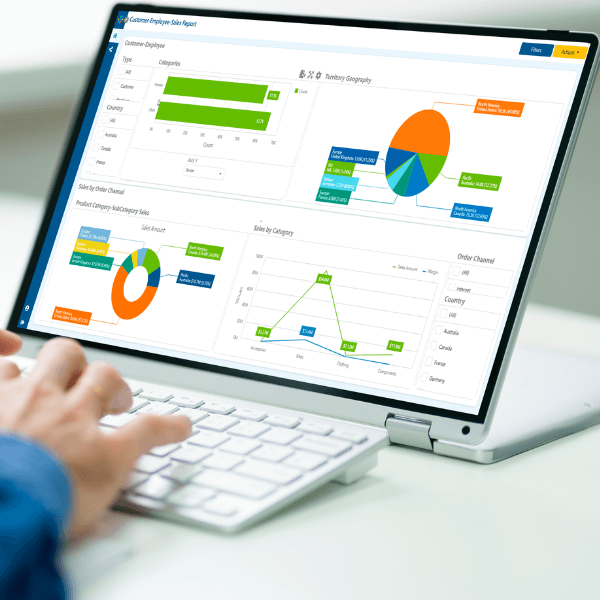
- Reports stop being technical and become visual, clear, and actionable.
- The user feels the tool supports them, instead of demanding more work.
This is where the experience stops being operational and becomes strategic.
The question worth asking
If your customers need to export data to understand what’s happening, the question isn’t technical—it’s strategic:
Are you helping your users make decisions, or just operate more efficiently?
Integrating analytics and reporting into your application isn’t “adding just another feature.”
It’s taking on a different role: moving from software provider to decision-making partner.
And that changes everything when it comes to retention.
Imagine this scenario
Your customer logs into your application and, without asking for help:
- Sees clear performance indicators.
- Identifies opportunities without downloading files.
- Trusts the data because it’s always up to date.
- Associates your platform with control, clarity, and confidence.
At that point, switching providers stops being an attractive option.
Because they’re no longer just using your system… they trust it.
When reporting stops being a pain and becomes an advantage
Companies that embed reporting directly into their applications don’t just improve the user experience:
- They reduce support tickets.
- Increase product usage.
- Reinforce perceived value.
- Build longer-lasting customer relationships.
This isn’t about selling dashboards.
It’s about designing experiences where data works in favor of retention.
And that’s where it becomes clear who truly understands their customers’ business.
If this scenario feels familiar and you’re wondering what an embedded reporting module could look like inside your own application,
you can book a demo and explore how to offer your users clarity, control, and a better experience without ever leaving your product.
Recent Articles

Fewer Reports, More Impact
June 13, 2025